NY Inspires: A Plan to Transform Education in New York State
NY Inspires is New York State’s initiative to transform education by creating more meaningful, engaging, and student-centered learning experiences. The initiative focuses on preparing students for success in college, careers, civic life, and beyond by emphasizing academic achievement, critical thinking, creativity, and real-world learning. NY Inspires aims to ensure all students have opportunities to demonstrate their knowledge and skills in ways that support their individual strengths and future goals.
Adopting the NYS Portrait of a Graduate
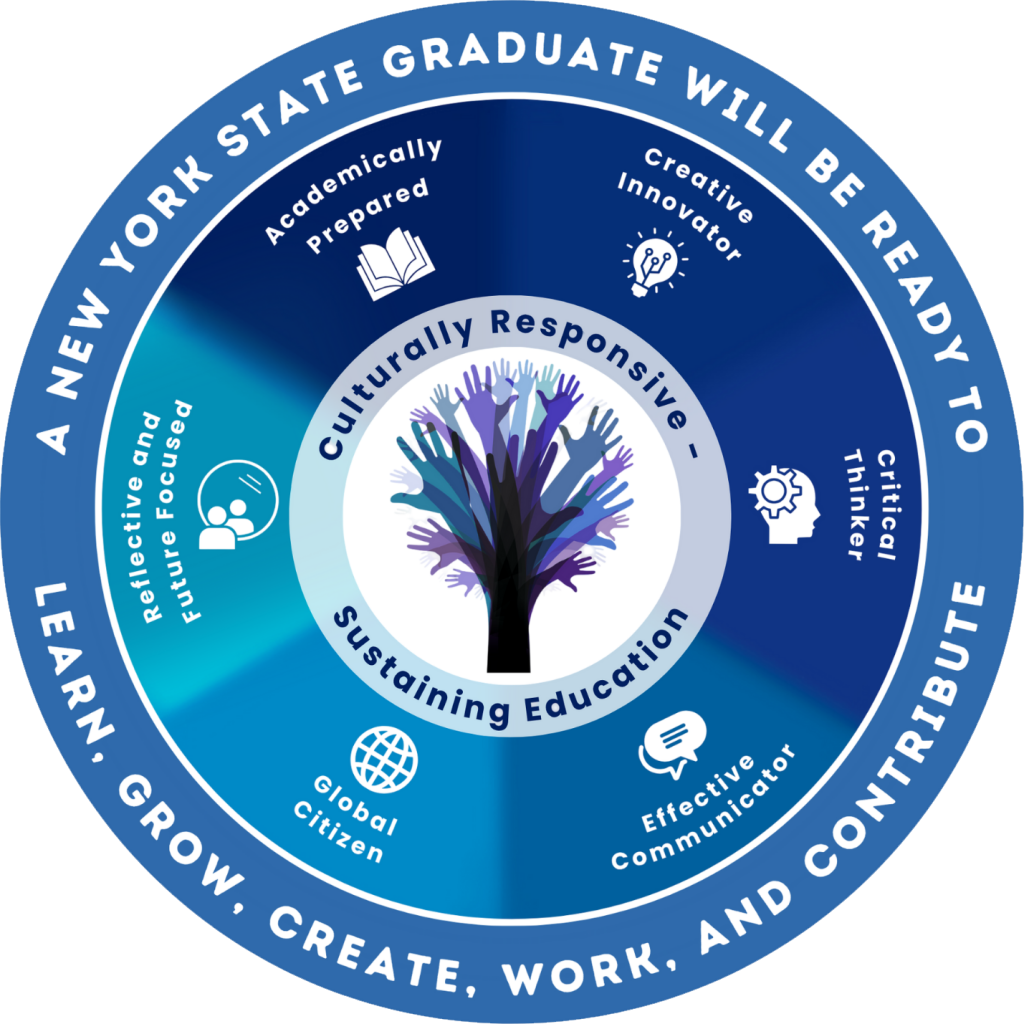
Portrait of a Graduate is New York State’s framework for defining the knowledge, skills, and qualities students should develop before graduating from high school. It focuses on preparing students to succeed in college, careers, and civic life by emphasizing six key attributes: being academically prepared, a creative innovator, a critical thinker, an effective communicator, a global citizen, and reflective and future-focused. Grounded in culturally responsive-sustaining education, the Portrait of a Graduate promotes meaningful learning experiences that prepare students to learn, grow, create, work, and contribute to their communities and beyond.
Transformation Timeline
Under the proposed timeline:
– Diploma assessment requirements would sunset in the Fall of 2027. Students graduating beginning January 2028 and after would not be required to pass Regents exams to graduate high school. Students will still be assessed in accordance with their district’s local assessment strategy. They may still take Regents exams to demonstrate learning and apply towards seals or endorsements.
– New York State would move to one diploma in the Fall of 2027. Beginning in 2028, all students who meet state graduation requirements will graduate with a NYS High School diploma. Students will still be able to earn seals and endorsements. Advanced Designation will be available as a seal or endorsement.
– Full implementation of the new, competency-based graduation system aligned with the New York State Portrait of a Graduate would begin for students entering high school in Fall of 2029.
The History of NY Inspires
Rethinking Our Education System, Together (2019-2023)
Education Transformation: The Spark (2019)
NY Inspires began in 2019 when Dr. Betty A. Rosa, then-Chancellor of the New York State Board of Regents, called for a reimagining of New York’s education system to better support all students and address gaps in student success. Her vision sparked statewide conversations among educators, parents, students, administrators, and school staff during regional meetings held from 2019 to 2022.
These discussions focused on several key questions: What knowledge and skills should students develop before graduation? How should they demonstrate their learning? How effective are Regents exams in measuring student achievement, graduation rates, and college readiness? What alternative measures, such as capstone projects, other assessments, and civic or community involvement, could demonstrate readiness for life after high school?
In response to these conversations, the Board of Regents established the Blue Ribbon Commission on Graduation Measures to explore new approaches to evaluating student learning and achievement. The commission was tasked with developing recommendations that would better reflect the needs of New York’s diverse student population and help ensure graduates are prepared for college, careers, and civic life.
The Graduation Measures Initiative (2019-2023)
The NY Inspires Graduation Measures Initiative progressed through three initial phases designed to gather input from communities across New York State, examine existing graduation requirements, and develop recommendations for the future of education. Through regional and virtual meetings, Blue Ribbon Commission discussions, and public presentations to the Board of Regents, the initiative encouraged stakeholders to consider how high school graduation could better reflect student learning and readiness for life beyond the classroom.
Phase 1: Information Gathering and Learning (2019–2022)
During the first phase, the New York State Education Department gathered feedback from educators, families, students, administrators, and other community members through 19 in-person regional meetings and eight virtual meetings held between 2020 and 2022. The Department also partnered with the Regional 2 Comprehensive Center to review research and compare graduation policies across selected states and countries. This work helped identify opportunities to strengthen graduation requirements and better measure student achievement.
Phase 2: Blue Ribbon Commission (2022–2023)
In fall 2022, the Blue Ribbon Commission on Graduation Measures began exploring the purpose of a New York State high school diploma and how it could promote both educational excellence and equity. The commission included approximately 40 members representing the diversity of New York’s schools and communities. Through committees and advisory groups representing educators, parents, and students, members worked collaboratively to develop recommendations for more meaningful graduation measures. Their work concluded with a three-day, in-person meeting in summer 2023.
Phase 3: Regents’ Discussion and Internal Work Group (2023)
In November 2023, the Education Department presented the commission’s recommendations to the Board of Regents for consideration. The recommendations included four priority areas, 12 recommendations, and an initial draft of the Portrait of a Graduate. Following the presentation, the Department established an internal work group to further examine the recommendations and gather additional stakeholder feedback to help guide the continued development of New York State’s graduation measures.
Recommendations of the Blue Ribbon Commission on Graduation Measures (2023)
After years of research and gathering input from educators, families, students, and community members, the Blue Ribbon Commission (BRC) concluded that New York State’s existing graduation requirements did not fully reflect the skills students need to succeed in college, careers, and civic life. The commission also found that rigid credit and assessment requirements limited students’ opportunities to demonstrate their knowledge, abilities, and real-world skills in different ways.
To address these challenges, the BRC developed four priority areas and 12 recommendations aimed at creating a more equitable and flexible graduation system. The goal is to ensure all New York State students have opportunities to develop the knowledge, skills, and competencies needed for success after high school.
Priority Areas
-
Multiple Pathways to One Diploma: Create a single diploma with opportunities for students to earn additional seals and endorsements that recognize their achievements.
-
Assessment Flexibility: Expand assessment options to allow students to demonstrate their learning in different ways.
-
Meaningful, Life-Ready Credentials and Skills: Emphasize practical knowledge, career preparation, and skills that support success beyond graduation.
-
Culturally Responsive Curriculum, Instruction, and Assessment: Ensure learning experiences reflect students’ diverse backgrounds, experiences, and needs.
Key Recommendations
The commission outlined 12 recommendations to guide the transformation of New York State’s graduation requirements:
-
Establish one high school diploma with opportunities to earn additional seals and endorsements.
-
Expand diploma credit requirements to include civic responsibility, cultural competence, financial literacy, fine and performing arts, STEM, and real-world writing skills.
-
Ensure all students have access to career and technical education (CTE), internships, and work-based learning opportunities.
-
Organize credit requirements into broader subject categories to provide greater flexibility in course selection.
-
Reduce or modify assessment requirements and expand the ways students can demonstrate proficiency.
-
Develop state-approved rubrics for performance-based assessments used to meet graduation requirements.
-
Establish tailored graduation requirements for students with unique circumstances, including newcomer and refugee students.
-
Allow assessment requirement exemptions for students with significant cognitive disabilities or extenuating circumstances.
-
Explore regulatory changes that would allow high school diplomas to be awarded posthumously.
-
Require teacher preparation programs to include culturally responsive-sustaining education (CRSE) practices and teaching methods.
-
Incorporate culturally responsive-sustaining education into professional development plans.
-
Review and update New York State learning standards.
Together, these recommendations provide a foundation for reimagining graduation in New York State, with an emphasis on equity, flexibility, meaningful learning, and preparing every student for life beyond high school.
NY Inspires: A Plan to Transform Education in New York State (2024-2029+)
Four Transformations: The Vision (2024)
At the June 2024 Board of Regents meeting, the New York State Education Department (NYSED) introduced a vision for transforming graduation requirements based on the Blue Ribbon Commission (BRC) recommendations. The vision outlined four key transformations designed to reshape the high school experience and better prepare students for college, careers, and civic life.
- Transformation #1: Adopt the New York State Portrait of a Graduate
The New York State Portrait of a Graduate will establish a shared understanding of the knowledge, skills, and competencies students are expected to demonstrate upon graduation. To earn a New York State high school diploma, students will need to demonstrate proficiency in both the Portrait of a Graduate and the New York State high school learning standards.
- Transformation #2: Redefine Credits and Learning Experiences
Student learning will extend beyond traditional, subject-specific courses to include a broader range of experiences that develop both content knowledge and essential skills for college and careers. These skills include applying knowledge, solving problems, communicating effectively, innovating, collaborating, adapting, and reflecting. In addition to traditional coursework, learning opportunities may include interdisciplinary project-based learning, career-connected learning, laboratories, seminars, virtual instruction, workshops, work-based and community-based learning, fieldwork, studios, and dual-enrollment courses.
- Transformation #3: Sunset Diploma Assessment Requirements
While high academic expectations will remain in place, students will have expanded opportunities to demonstrate their learning and achievement. Beginning in the 2027–28 school year, passing Regents Exams will no longer be a requirement for earning a New York State high school diploma. School districts will continue to assess students using multiple measures, and students will still participate in state assessments required under federal law. Regents Exams will remain available as one option for demonstrating proficiency, alongside additional ways for students to showcase their knowledge and skills.
- Transformation #4: Move to One Diploma
All students who meet state graduation requirements will earn a New York State high school diploma. This change will eliminate the local diploma, while the Advanced Designation will become a seal or endorsement. School districts will also have the authority to establish additional seals and endorsements to recognize students’ achievements.
Following the announcement of this vision, NYSED provided additional opportunities for stakeholder input through a series of BRC Ambassador Forums. In November 2024, the Department presented NY Inspires: A Plan to Transform Education in New York State to the Board of Regents, further advancing the proposed changes to graduation measures and requirements.
Informed by feedback from the public and members of New York State’s education community, the NY Inspires Plan reflects a range of stakeholder needs and perspectives. It provides a roadmap for implementing the four transformations, which are grounded in the 12 recommendations outlined in the BRC report.
The Portrait of a Graduate (2025)
In July 2025, the New York State Board of Regents adopted the New York State Portrait of a Graduate as part of the state’s broader effort to transform education and graduation requirements. The Portrait supports the P–20 education continuum by establishing a vision for graduates who are prepared and empowered to make meaningful contributions to their communities and beyond.
The Portrait emphasizes the development of critical thinking and problem-solving skills by encouraging students to think deeply, apply their knowledge, and address complex challenges. It also promotes greater flexibility and creativity in instructional practices, enabling educators to respond to the diverse needs, strengths, and developmental levels of learners. Through these approaches, learning can become more relevant, engaging, and meaningful for all students.
Grounded in culturally responsive-sustaining education, the Portrait identifies the interconnected skills and attributes students need to succeed in college, careers, and their communities. These qualities are intended to inform everyday teaching and learning, ensuring that educational experiences meet students where they are developmentally and prepare them to continue learning, grow, create, work, and contribute throughout their lives.
- Explore the New York State Portrait of a Graduate to learn more about the vision and the attributes expected of every graduate.
New York State’s Educational Assessment Strategy (2025)
The NY Inspires initiative emphasizes providing students with multiple opportunities to demonstrate their knowledge, skills, and abilities. Evidence of college, career, and postsecondary readiness should come from a variety of sources, with each contributing to a comprehensive understanding of students’ learning, achievements, and preparedness for life beyond high school.
To support educators in gathering meaningful evidence of student learning and help schools develop intentional assessment strategies that reflect their communities’ values and priorities, the New York State Education Department released New York State’s Educational Assessment Strategy in early 2025. The strategy emphasizes the importance of collecting information from multiple sources to develop a more complete understanding of student learning. Educators can use this information to make informed decisions, identify individual learning needs, and determine how best to support each student’s continued growth and success.
- Read New York State’s Educational Assessment Strategy
- Visit the Educational Assessment Strategy webpage for additional tools, resources, and implementation guidance.
Moving Toward a First-in-the-Nation Competency-Based System (2026+)
In June 2026, the New York State Education Department announced plans to transform the state’s graduation requirements, shifting from a time-based model toward an approach that emphasizes students’ demonstrated readiness. This transition represents a historic step toward establishing a competency-based P–12 education system, in which students demonstrate the knowledge, skills, and competencies needed to succeed in college, careers, civic life, and beyond high school. The initiative marks a significant change in New York’s graduation system and aims to position the state as a national model for educational excellence.
The new diploma framework will be built around New York State competencies aligned with the Portrait of a Graduate and prioritized learning standards, ensuring that graduation reflects students’ demonstrated learning and readiness for their next steps.
A Research-Driven, System-Wide Evolution
Informing the Vision: Exploratory Research & Data Collection
Between 2019 and 2024, the New York State Education Department (NYSED) examined high school graduation requirements and assessment practices across states and countries to better understand existing approaches. During this period, the Department also engaged thousands of stakeholders in discussions about what a New York State high school diploma should represent and the knowledge, skills, and competencies graduates should possess.
These research and stakeholder engagement efforts helped inform the work of the Blue Ribbon Commission on Graduation Measures and laid the foundation for the four transformations outlined in the NY Inspires initiative.
Literature Reviews Conducted for NYSED
Exploring National Trends (2019-2020)
NYSED partnered with Achieve in the first phase of the Graduation Measures initiative to begin compiling research, information, and regional meeting feedback.
- In December 2019, representatives from Achieve presented a review of graduation requirements to the Board of Regents, including case studies on the high school graduate profile from Massachusetts, New Jersey, Indiana, and Ohio.
- Achieve found a shifting landscape across the nation, with states modifying or adding to the number of options available to students to graduate from high school; making adjustments to assessments required for high school graduation; and exploring innovative approaches to high school pathways, such as competency-based diplomas, the use of performance-based assessments, and the inclusion of experiential learning opportunities.
Analyzing National & International Policy and Practice (2020-2022)
From 2020-2022, NYSED partnered with the Region 2 Comprehensive Center (R2CC), led by WestEd, to conduct a literature review on graduation requirements and measures, including a policy and practice scan of 7 states and 4 countries, as well as an analysis of New York’s stakeholder feedback collected.
- To the question: What graduation requirements promote educational excellence for all students, including members of special and vulnerable populations? R2CC’s literature review found:
- Optional rigorous coursework, college preparatory programs, and greater exposure to math in high school tend to yield more positive college outcomes; and optional rigorous coursework, greater exposure to math, and nonacademic skills lead to greater career outcomes.
- Student completion of optional rigorous coursework has a positive impact on college enrollment, college retention, and bachelor’s degree attainment.
- Assessments required for graduation—like high school exit exams—were not positively associated with any college or career outcomes
- Based on the review of the seven states, key skills and knowledge areas emerged as critical to students’ postsecondary readiness, and several legislative and policy changes were highlighted that will impact graduation requirements for future classes of U.S. students.
- The policy changes emphasized such things as proficiency in financial literacy, digital equity, increased access to career planning and work-based learning, civic engagement, and the opportunity to earn diploma seals or badges.
- All seven states provided varied pathways to graduation, an increased focus on career planning, and/or increased personalization rather than the more traditional one-size-fits-all approach.
- In review of New York’s stakeholder regional meetings, survey, and ThoughtExchanges, R2CC found:
- When asked what students should know and be able to do, stakeholders primarily discussed 21st-century skills, civic readiness, and career, college, and life skills.
- When asked how these skills should be measured, stakeholders suggested performance-based measures that were more flexible and tailored to students’ unique needs.
- Reported considerations emphasized an increased focus on key skills to prepare students for post-graduation and on equitable assessment opportunities for all students.
Stakeholder Feedback Collected by NYSED
Blue Ribbon Commission Monthly ThoughtExchange Questions (2022–2023)
As part of the Blue Ribbon Commission (BRC) on Graduation Measures, NYSED gathered stakeholder perspectives through monthly ThoughtExchange discussions. These conversations explored the knowledge, skills, experiences, and supports students need to succeed after high school, as well as opportunities to improve the high school experience.
December 2022: Skills and Abilities for Postsecondary Success
Guiding question: What skills and abilities do New York State graduates need most to succeed in their chosen postsecondary pathways?
- Key themes: Communication, critical thinking and problem-solving, and collaboration.
- Read the December 2022 ThoughtExchange results.
January 2023: Meaningful High School Opportunities and Experiences
Guiding question: What courses, opportunities, and experiences should high schools offer to align with students’ needs, aspirations, and career exploration goals? Which should be required?
- Key themes: Financial literacy, career exploration, and life skills.
- Read the January 2023 ThoughtExchange results.
February 2023: Developing Foundational Skills
Guiding question: Foundational skills such as initiative, time management, and collaboration support success in school, college, careers, civic engagement, and everyday life. How can K–12 education better cultivate these skills?
- Key themes: Internships and work-based learning, as well as project-based and performance-based learning.
- Read the February 2023 ThoughtExchange results.
March 2023: Rethinking the High School Experience
Guiding question: If you could design or redesign your high school experience, what would it look like, and why would it be valuable?
- Key themes: Less reliance on traditional standardized testing, more real-world learning opportunities, and more authentic, hands-on experiences.
- Read the March 2023 ThoughtExchange results.
April 2023: Addressing Barriers to Student Achievement
Guiding question: What visible and less apparent barriers to student achievement are not adequately addressed by current graduation requirements, and how can those barriers be overcome?
- Key barriers identified: Mental health challenges, large class sizes, and inadequate funding.
- Potential approaches: Expanded vocational training, personalized instruction, and greater emphasis on interpersonal and other essential life skills.
- Read the April 2023 ThoughtExchange results.
Stakeholder Feedback on the Four Transformations (2024)
In 2024, NYSED gathered additional stakeholder feedback on the four transformations proposed through the NY Inspires initiative. The feedback highlighted potential implementation challenges and opportunities to improve student learning, expand educational options, and promote greater equity in graduation outcomes.
Review the stakeholder feedback presentation to the Board of Regents.
Transformation #1: Adopt the New York State Portrait of a Graduate (Slides 4–5)
Challenges identified:
- Managing implementation logistics and resource requirements.
- Ensuring consistency and equitable application across schools and districts.
- Developing effective methods for assessing student competencies.
- Providing adequate professional learning opportunities for educators.
- Addressing financial and resource constraints.
Opportunities identified:
- Expanding flexibility and student choice.
- Creating multiple pathways to graduation.
- Promoting a more holistic, well-rounded education.
- Strengthening real-world learning and career readiness.
- Advancing a more equitable and inclusive education system.
Transformation #2: Redefine Credits and Learning Experiences (Slides 6–8)
Challenges identified:
- Ensuring equitable opportunities across districts.
- Establishing consistent assessment practices.
- Securing sufficient funding and resources.
- Providing professional learning and support for educators.
- Effectively monitoring student progress.
Opportunities identified:
- Developing personalized learning pathways.
- Increasing student engagement and participation.
- Connecting classroom learning to real-world applications.
- Expanding equitable access to educational opportunities.
- Providing greater flexibility in how students earn credit.
Transformation #3: Sunset Diploma Assessment Requirements (Slides 9–10)
Challenges identified:
- Maintaining equity and consistency in implementation.
- Providing adequate training and implementation support.
- Monitoring student progress effectively.
- Preserving academic rigor and accountability.
- Communicating changes clearly to students, families, and educators.
Opportunities identified:
- Better accommodating the diverse needs of all students.
- Expanding the ways students can demonstrate proficiency.
- Emphasizing practical skills and readiness for life after high school.
- Reducing test-related stress and anxiety.
Transformation #4: Move to One Diploma (Slides 11–12)
Challenges identified:
- Managing implementation and resource needs.
- Ensuring clear communication and understanding of the changes.
- Promoting equitable access to opportunities.
- Maintaining high academic standards.
- Supporting schools and students through the transition.
Opportunities identified:
- Advancing equity and inclusion in graduation outcomes.
- Expanding access to postsecondary education and career opportunities.
- Reducing student stress associated with differentiated diploma pathways.
- Supporting more personalized learning experiences.
Taken together, the ThoughtExchange discussions and stakeholder feedback provided insight into the priorities, concerns, and aspirations of New York’s education communities. The recurring themes of transferable skills, personalized learning, authentic experiences, equitable opportunities, and multiple ways to demonstrate proficiency helped inform the broader conversation about modernizing graduation requirements through the NY Inspires initiative.
|
|
 ParentSquare  Facebook  Instagram |
 LOCATION:
 PHONE:
 FAX:
 DAYS/TIME: